IaC Security Tools: Choose by Control Coverage, Not Logos
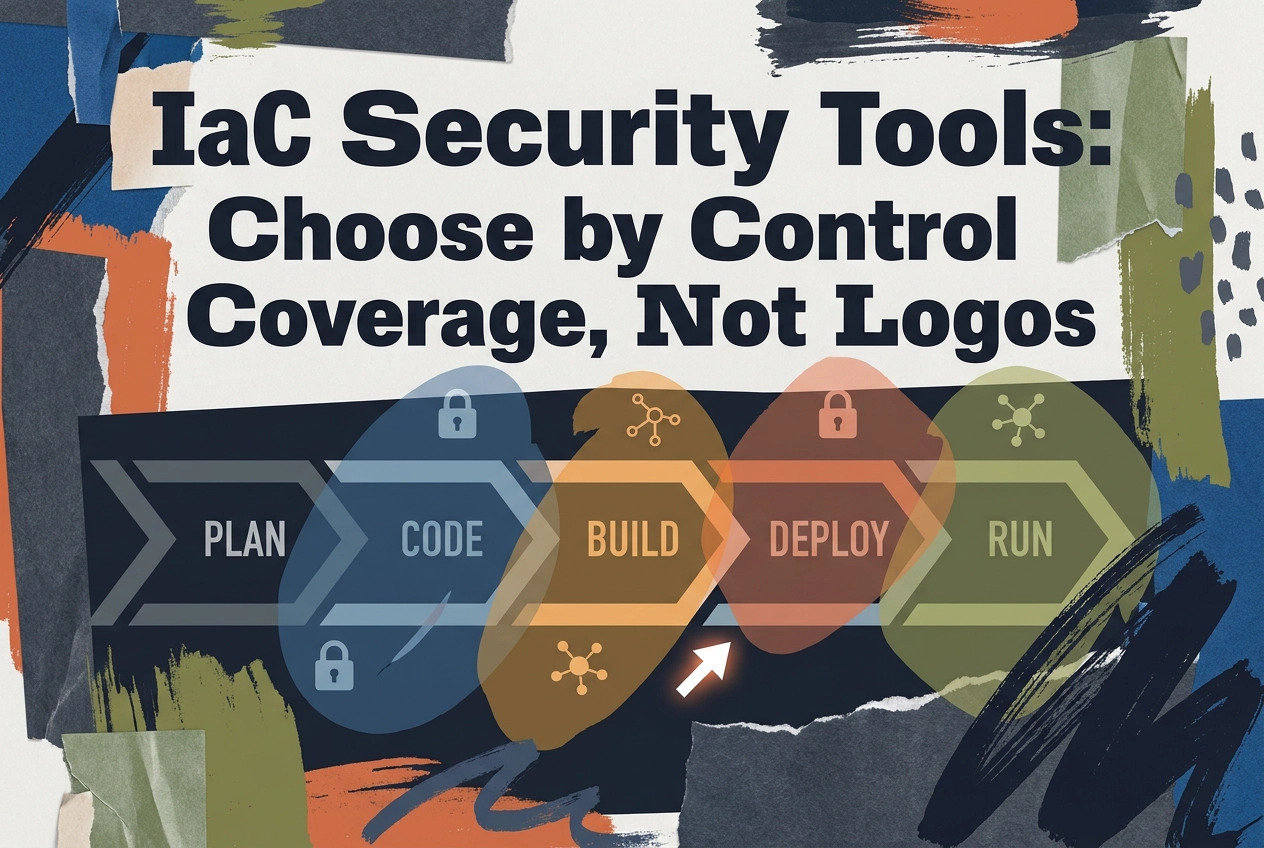
A familiar dashboard logo tells you what a vendor sells. It does not tell you which control gap your Terraform pipeline leaves open. That distinction matters more than most buyers admit, and it is the reason this analysis organizes the IaC security category by the control each layer actually closes: static analysis, policy-as-code, artifact signing, drift detection, and runtime posture. Instead of comparing security scanning tools by brand recognition, we will map them to the change lifecycle every IaC change passes through: authoring, publishing, planning, and running. Each section examines one control layer, states plainly what it closes and where its authority ends, then places it on that lifecycle map so you can see which stage nobody owns. That exercise surfaces the gap no scanner fills: the provenance of the module itself. We will close by treating signed, statically validated, version-pinned modules as a toolchain component rather than an afterthought, and by showing how to run the same coverage exercise on your own stack. NIST SSDF v1.1 is a useful reference point along the way, though applying it to IaC modules remains an inference, not a documented claim.
Why Choosing IaC Security Tools by Logo Leaves Gaps
Most teams don't select IaC security tools so much as inherit them: a scanner from a previous employer, a conference demo, or a cloud vendor bundle. That tool then quietly becomes the security program for every Terraform and OpenTofu file.
The failure is structural. A scanner strong at authoring does nothing for publishing, planning, or running. Buying it doesn't shrink the uncovered surface; it relocates it.
This piece argues for a different method: organize the category by the control each layer closes, then map those controls onto the change lifecycle to find the stage nothing covers. It is a selection framework, not a ranked product list, and it names one gap no scanner in the category fills.
Recognition is not coverage. NIST states that identifying commercial entities "is not intended to imply recommendation or endorsement" (NIST SP 800-218 v1.1, February 2022). Apply that same skepticism to logos when choosing IaC tools for your team.
Reading the Security Scanning Tools Market as Control Layers
The alternative to logo matching is a control-layer inventory. A control layer names the specific failure it prevents and the evidence it produces when the check passes: a report, signature, or alert. This piece walks five: static analysis, policy-as-code, artifact signing, drift detection, and runtime posture. Market categories do not align one-to-one with these layers. A product can partially cover two and fully cover none, which is why Terraform and supply-chain security depends on reading capabilities, not badges. This framework reasons about control coverage only. It does not map controls to SOC 2, FedRAMP, or PCI, because no sourced mapping is available and inventing one would mislead.
Static Analysis: What It Closes Before Anything Reaches a Plan
Static analysis reads Terraform, OpenTofu, or Ansible source and flags misconfigurations and insecure defaults before a plan is ever generated. It belongs at authoring and pre-commit, and works well as a pull request gate that blocks a merge instead of filing a backlog ticket.
It does not close three things: whether the module came from a trusted author, whether the published artifact matches what was reviewed, and what the plan proposes against live state. Those belong to publishing and planning controls.
Rule freshness is a selection question, not a fixed property. Coverage tracks provider releases, so ask how quickly a scanner adds rules for the resources you actually run, and read when static validation is the honest answer before you assume a green scan settles provenance.
Policy-as-Code: Turning Written Standards into Enforceable Checks
Static analysis judges code as written; policy-as-code judges the change as proposed. It closes the gap between a written internal standard and what your pipeline will actually accept by encoding that standard as an executable test. It sits at planning and pre-apply, where the evaluated plan, not the source, gives policy engines concrete resources, attributes, and dependencies to inspect. Its limit is translation: it enforces only the rules you wrote, so coverage is bounded by how completely your standards became checks. Before adopting another engine, ask how many of your written standards currently exist as rules, and who reviews the ruleset after each cloud provider release. That review discipline matters as much as the tool, a point What Infrastructure as Code Actually Means in Practice makes concrete.
Artifact Signing: Proving What Actually Shipped
Policy-as-code governs what the pipeline accepts at plan time. Artifact signing answers a different question: did the module or stack that reached an environment arrive exactly as reviewed? A signature or attestation closes that gap by tying a specific artifact to its origin and integrity, so consumers verify rather than assume. It sits at publishing, between the validated source and the downstream download.
It remains underused for IaC because script and module distribution outpaced signing practice. Many teams sign container images but apply unsigned Terraform, OpenTofu, or Ansible content. You can verify a download yourself against its published signature, but that proves origin and integrity only. A valid signature does not show the module is well written or free of insecure patterns. Signing closes the shipping question, not the quality question.
Drift Detection: Catching What Changed After Apply
Signing proves what shipped, not what the environment still looks like. Drift detection closes the divergence between declared state and live state, including manual console edits and changes made by other automation. It sits in the running stage, continuously or on a schedule, after apply completes. That matters because a repository clean at authoring can describe a reality that no longer exists, which is a compliance and security problem, not a cosmetic one. NIST's continuous monitoring framing supports post-apply oversight, though drift tooling implements it directly. What drift does not close: it reports divergence; it does not establish that the original declared state was safe. Coverage still depends on controls upstream.
Runtime Posture: The Layer That Stops Being IaC's Job
Drift detection tells you the environment moved; it cannot tell you whether what it moved into is safe. Runtime posture covers exposure and permission problems in the running environment: publicly reachable storage, overbroad roles, and identity misconfigurations that surface only once workloads authenticate against real systems. CISA and NIST guidance on cloud identity token misuse points at the same territory.
This layer sits furthest from your Terraform files, and the distance is the point. A correct plan can still leave risk behind, because an inherited role or a provider default can change beneath you.
Settle the handoff question explicitly: at what point does your team agree authoring tooling stops being the right instrument, and runtime tooling takes over? The IaC stack has two layers now, and the running one needs an owner.
Mapping Controls to the IaC Change Lifecycle
Runtime posture marks the edge of IaC's own instrumentation. Plot the layers against the four lifecycle stages and responsibility distributes cleanly. At authoring, static analysis and pre-commit checks do the heavy lifting because source is written and reviewed there. At publishing, signing and version pinning carry the load because a module or stack is distributed. At planning, policy-as-code gets its clearest signal because the change is evaluated against real state. At running, drift detection and runtime posture are what see the existing environment. Read this as a coverage grid. For each stage, name the responsible layer, then mark cells where the answer is genuinely nothing; a stage can be broadly covered and still leave specific controls unowned. The four-stage grid is this piece's own model, offered as a selection framework. Readers can compare it against NIST SP 800-218, a voluntary secure-software-development reference published in February 2022, which does not itself prescribe infrastructure-as-code controls. The exercise also clarifies how infrastructure as code actually works across authoring and runtime, and leaves a map for finding the uncovered column.
Reading the Map: Finding the Stage Left Uncovered
Once the grid is drawn, the pattern is rarely even. In the reasoning this piece follows, most teams have two or three stages well covered and at least one stage with no owner at all. The usual shape: strong authoring controls, serviceable planning policy, then a near-empty publishing column for infrastructure code.
That gap stays invisible because an unmanaged stage produces no reports. Nothing in your dashboards flags it, and absence of evidence starts to look like absence of risk.
Run one concrete check. For every module your team consumes, can you name who authored it, whether it was validated, and whether what you downloaded matches a signed artifact? If any answer is no or unknown, publishing is your uncovered stage.
That reframes tool selection. Choose a tool to close an identified stage gap, not because it has the best reputation.
The Provenance Gap No Terraform Security Scanning Tool Closes
The empty column is usually provenance: the verifiable history of a module's origin, validation, and distribution, independent of its current contents.
This is why Terraform security scanning cannot close it, for the trusted-author limit the static analysis section already flagged. Treat the claim that this is the most commonly unmanaged stage as a hypothesis, not a finding. Test it: for each module you consume, can you name who wrote it and what evidence backs that? When a consumption-time scan is the only control, every consumer repeats the same work and inherits the same blind spot. No sourced statistic supports a prevalence claim here; the case rests on control-coverage logic. For the limits, see what that leaves open.
What Signed, Statically Validated, Version-Pinned Modules Change
One way to close the publishing stage is to move validation and signing upstream, outside your own pipeline. IaC Bazaar describes its catalog as verified, plug-and-play Terraform, OpenTofu, and Ansible modules that are statically validated, security-scanned, and cosign-signed, downloadable per module starting at $29 with no subscription required.
Each property closes a distinct question. A signature addresses origin and integrity, which SLSA frames as confirming that the code you rely on is the code you are actually using. Static validation addresses review. Version pinning addresses silent change of a dependency beneath you.
Respect the claim ceiling: a validated, signed module is not a guarantee that it is free of every vulnerability. Pair catalog consumption with your own policy-as-code and drift detection rather than replacing them. The description also states Vizier, an orchestrator backed by the verified catalog, and curated production-ready stacks for AWS, EKS, and GKE, which carry the same coverage from single modules into full stacks.
Running the Control Coverage Exercise on Your Own Stack
The same discipline applies to your own stack: verify what you run, not just what you consume. Start by listing every tool and the single lifecycle stage it actually owns, not the stage its marketing emphasizes. Next, build a four by five grid, authoring, publishing, planning, and running against the five control layers, marking each cell covered, partial, or nothing. Treat every empty cell as a procurement or policy question; treat every partial as a configuration question before it becomes a purchase. Revisit the grid whenever you adopt a new provider, language, or distribution method, since convention can quietly stop covering a stage. Finally, evaluate candidates by the evidence they produce, reports, signatures, attestations, not by the logo on their documentation.
Conclusion: Select by Coverage, Verify by Provenance
Once the grid is filled, the selection method becomes simple: name the control, name the lifecycle stage, then find the stage with no owner before you compare products. Three takeaways should survive the exercise. Static analysis is an authoring control. Policy-as-code is a planning control. Signing with version pinning is the publishing control most pipelines leave empty. The honest concession still anchors the argument: no scanner resolves the provenance of the module itself. Pair scanning with a supply chain that validates and signs before distribution. Then run the grid on your current toolchain, identify the empty column, and evaluate options against that specific gap rather than against reputation.
More from the blog
Production-Ready Terraform Stacks for EKS and GKE
A production EKS or GKE stack is a composition of seven control groups, not one Terraform module. This piece gives you a rubric for judging what a stack really closes, and what your team still has to own.
2026-11-12من وحدات Terraform متفرقة إلى Stack EKS متماسك في الإمارات
معظم الفرق الإماراتية تملك وحدات Terraform جاهزة، لكن ما ينقصها هو التركيب والتوصيل بينها. هذا الدليل يتبع مسار التجميع خطوة بخطوة ليكشف أين يختبئ الانحراف وأين تنكسر بيئة الإنتاج.
2026-11-11ستاك AWS الإنتاجي في السعودية: قائمة تحقق قبل الإطلاق
هل اخترت الـ Stack الإنتاجي على AWS لأن قائمة ميزاته طويلة؟ هذا الدليل يحوّل السؤال إلى قائمة تحقق تربط كل متطلب إطلاق في السعودية بالمكوّن الذي يلبيه، فتعرف الجواب قبل أن يكلّفك التصحيح بعد الإطلاق.
2026-11-07